
How APAA advisor Heather Marx shaped a public art program connecting five blocks of downtown Redwood City through art, history, and community.
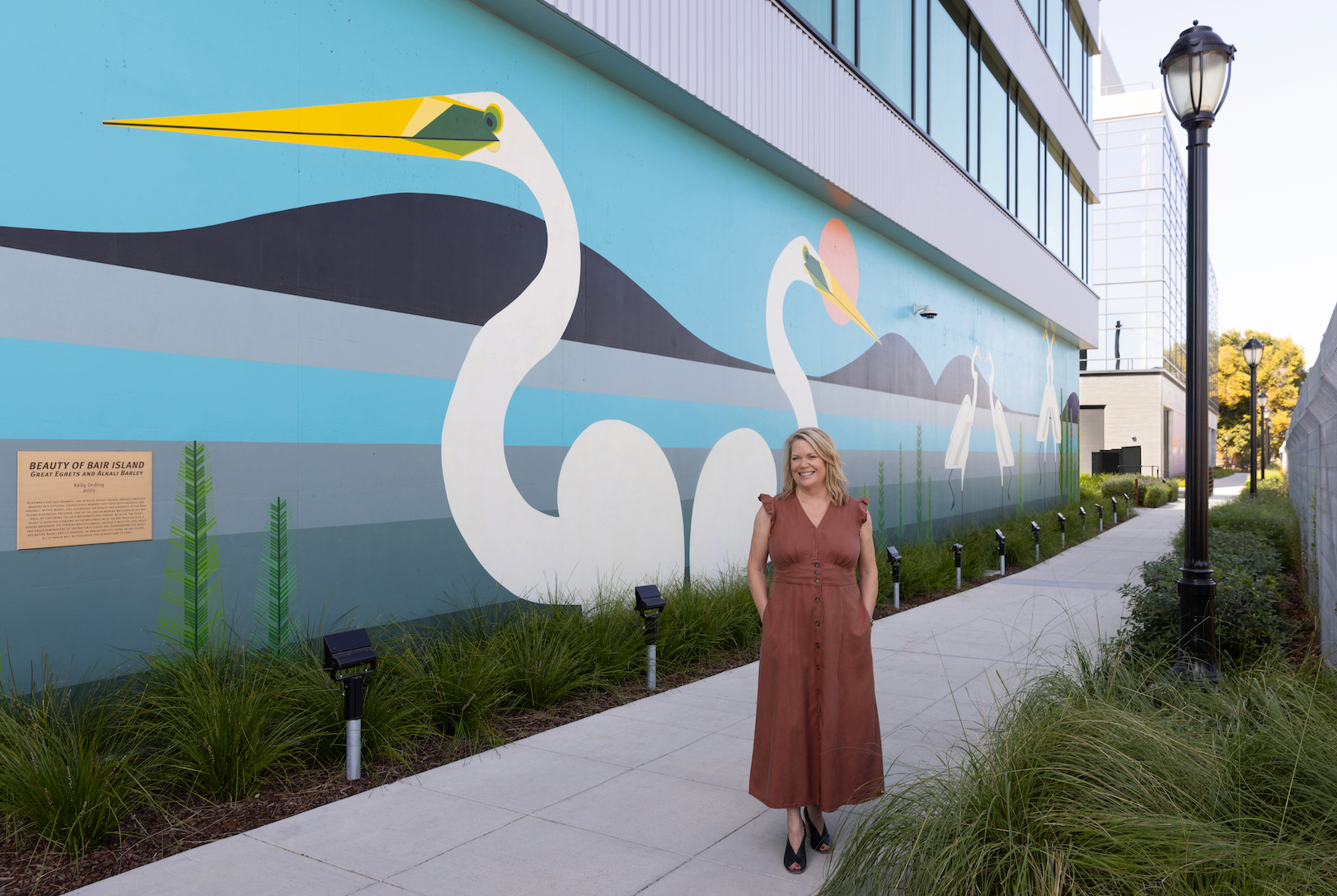
Heather Marx with Beauty of Bair Island by Kelly Ording. Photo by Kait Miller.
For more than a decade, art advisor and APAA member Heather Marx had been waiting for the right setting for an Erwin Wurm sculpture. That opportunity emerged at Elco Yards, where five blocks of former warehouses, auto dealerships, and surface parking were being transformed into a new neighborhood in downtown Redwood City, California.
“I have artists I’m intrigued by that I keep in my back pocket, waiting for a project that fits,” Marx says.
Wurm’s Step, an oversized work bag walking on sneakers customized for the site, was installed in May 2026. Approximately fourteen feet tall, it is the artist’s first permanent public sculpture on the U.S. West Coast, and the eleventh and final work in a program Marx began developing in 2019.
Its arrival marked the culmination of more than six years of research, artist selection, public review, and coordination. For Marx, the task extended beyond choosing individual works: she helped establish how contemporary art would contribute to the identity and everyday experience of an emerging neighborhood.
Art at the planning table
Marx joined Elco Yards before construction began and remained through IQHQ’s acquisition of the development in 2021. Working alongside architects WRNS Studio, landscape architects SWA, the developer, and the Redwood City Arts Commission, she helped conceive the art program in relation to the architecture and public spaces. A committee of local residents also helped shape its early direction.
As a one percent for art projects, Elco Yards sets aside at least one percent of total construction costs for on-site public art. The completed program represents more than $2 million in commissioned work, with all eleven works outdoors and freely accessible.
“My mission was to create a vital art program that embodies Redwood City’s rich history and the community living here now,” Marx says. “Every artist was asked to research the city and to make something joyful and impactful. You should not need to read a label to enjoy any of these works.”
That ambition guided both the selection of artists and the relationships among their commissions. Each work needed a distinct presence, while contributing to a collection encountered on foot across streets, parks, and pedestrian pathways.
Translating a vision into commissions
Marx considered prospective artists’ practices alongside their public art experience, engagement with the site, and ability to deliver work at the required scale and on schedule. An initial presentation of approximately fifty pages helped the developers and architects consider different approaches and establish a shared direction.
Placement required a similarly broad view. Each building had its own architectural character, materials, and palette. Below ground, parking structures and utilities affected what could be supported above them. Sightlines, reflections, and the surrounding landscape informed how visitors would experience each work.
Marx’s role connected these artistic and practical considerations. She developed proposals that stakeholders could evaluate through artist biographies, examples of previous commissions, and supporting research. Public review also addressed ordinance compliance, safety, and cultural sensitivities.
For Wurm’s commission, that preparation included traveling to England to experience his work firsthand.
“I flew to the Yorkshire Sculpture Park in England to see Wurm’s solo show to solidify my case to the developer and the arts commission,” Marx says. “There is retail, food, business, and community moving through this campus, and Step captures all of that energy without being literal about it.”
The sneakers distinguish the Elco Yards commission from every other sculpture in Wurm’s ongoing Walking Bag series. Realizing the work also required coordination among the artist, developer, legal teams, and installation specialists: a process encompassing rights, materials, structural requirements, and the sculpture’s long-term presence outdoors.
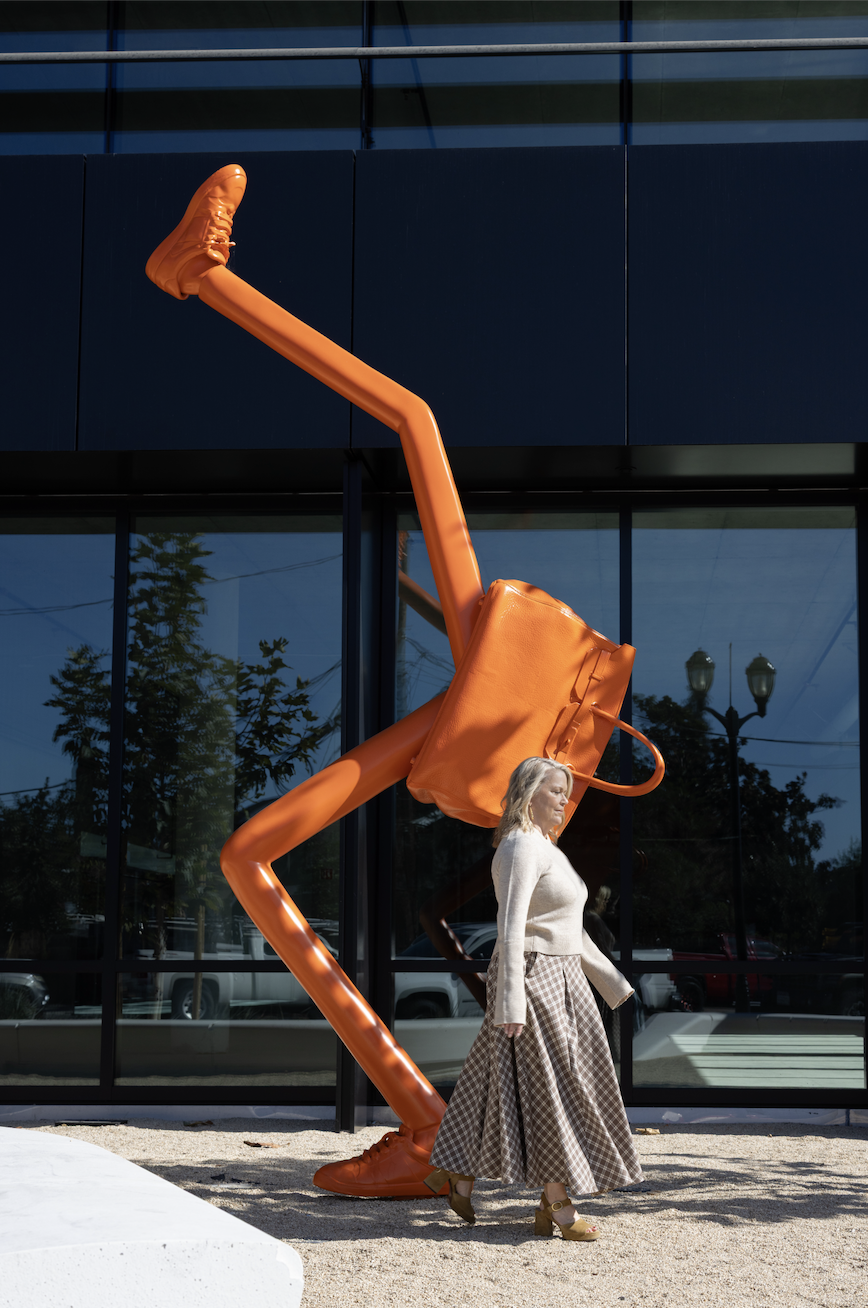
Heather Marx with Step by Erwin Wurm. Photo by Kait Miller.
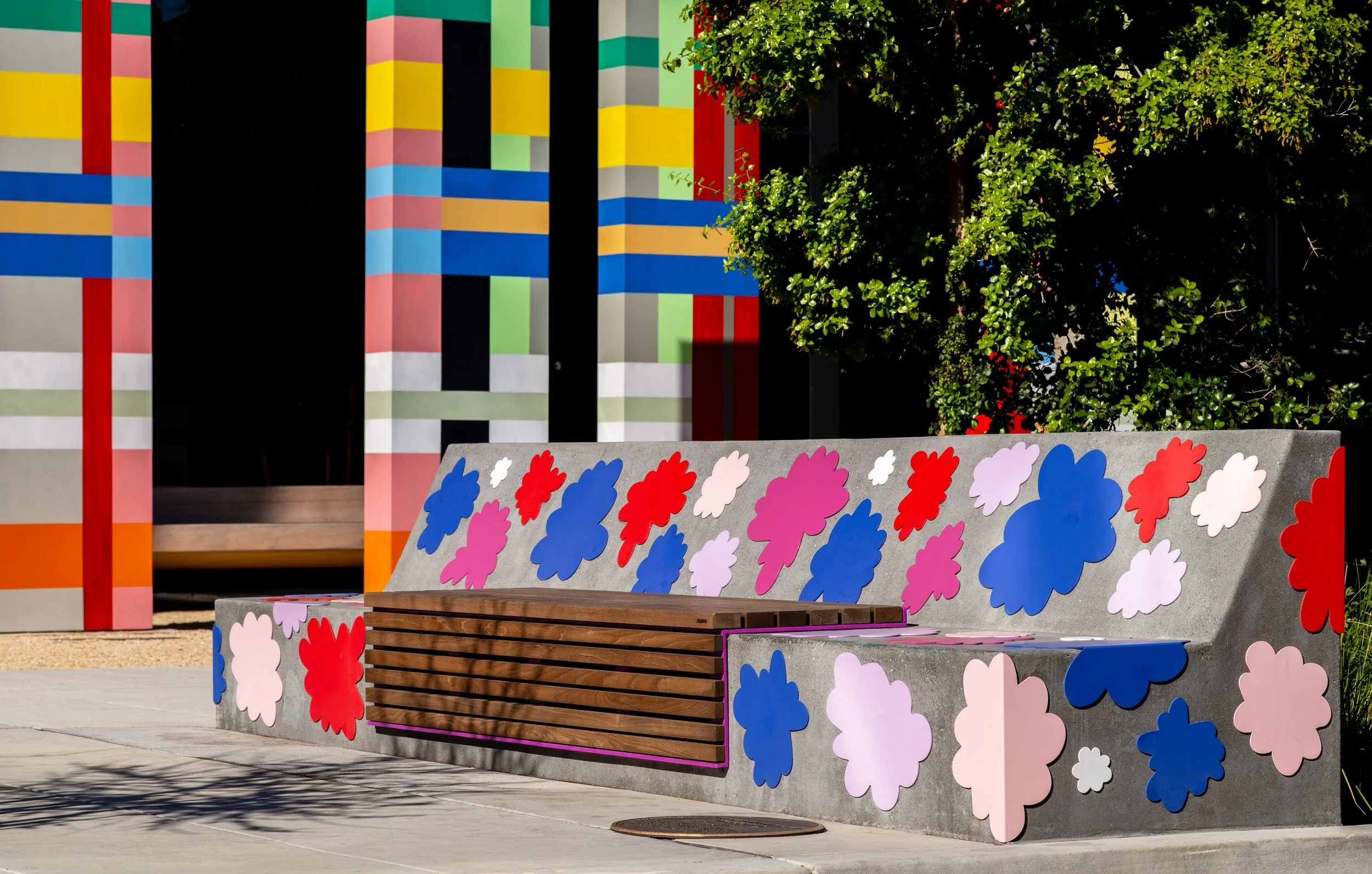
Crysanthemum Crossing by Leah Rosenberg, with Chrysanthemum by Pard Morrison in the background. Photo by Breadtruck Films, Courtesy of IQHQ.
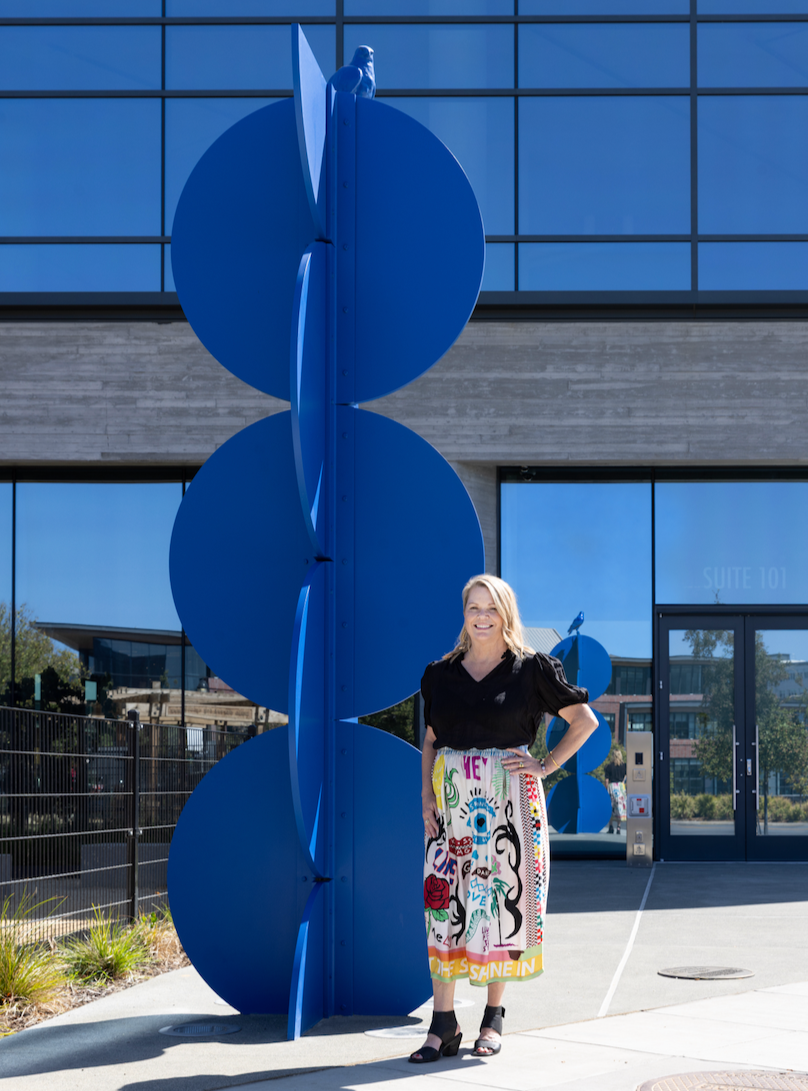
Heather Marx in Front of Everything is Connected by Nathan Mabry. Photo by Kait Miller.
Local histories, distinct artistic perspectives
Throughout Elco Yards, the commissions connect contemporary artistic practices with histories that might otherwise be overlooked.
On Lathrop Street, two works recall Redwood City’s former identity as the “Chrysanthemum Capital of the World.” Pard Morrison’s Chrysanthemum comprises four patinated aluminum columns, their fired layers of color evoking the flower fields once central to the local economy. Nearby, San Francisco artist Leah Rosenberg’s Chrysanthemum Crossing brings stenciled blossoms to three concrete benches.
Together, the works acknowledge the Japanese American growers who helped build the city’s flower industry beginning in 1907 and whose businesses were disrupted by wartime incarceration.
“Color is usually where I start, but with Chrysanthemum Crossing, the history came first and the color followed,” Rosenberg says.
At Shed Park, Oakland-based duo MCXT, Monica Canilao and Xara Thustra, created Caretake This Land on The Shed, a contemporary reconstruction of the historic Perry’s Feed & Fuel building. Their composition draws together Redwood City’s waterways, port history, chrysanthemum legacy, and Ramaytush Ohlone basketry patterns. During the five-and-a-half-week installation, neighborhood children contributed painted handprints and initials.
Across from The Shed, HYBYCOZO’s Halite references the crystalline structure of salt and the nearby salt ponds. The artists left the Corten steel raw in response to the building opposite it. After dark, interior lights project the sculpture’s intricate pattern across the pavement, extending the work into its surroundings.
Local ecology provides another connection across the site. Kelly Ording’s two murals along the Caltrain pedestrian path honor the Bair Island Ecological Reserve, a place she visited as a child. At the Main Street Dog Park, Nathan Mabry’s Everything is Connected places a bronze red-tailed hawk above stacked circular forms. A companion elsewhere on campus invites visitors to continue looking.
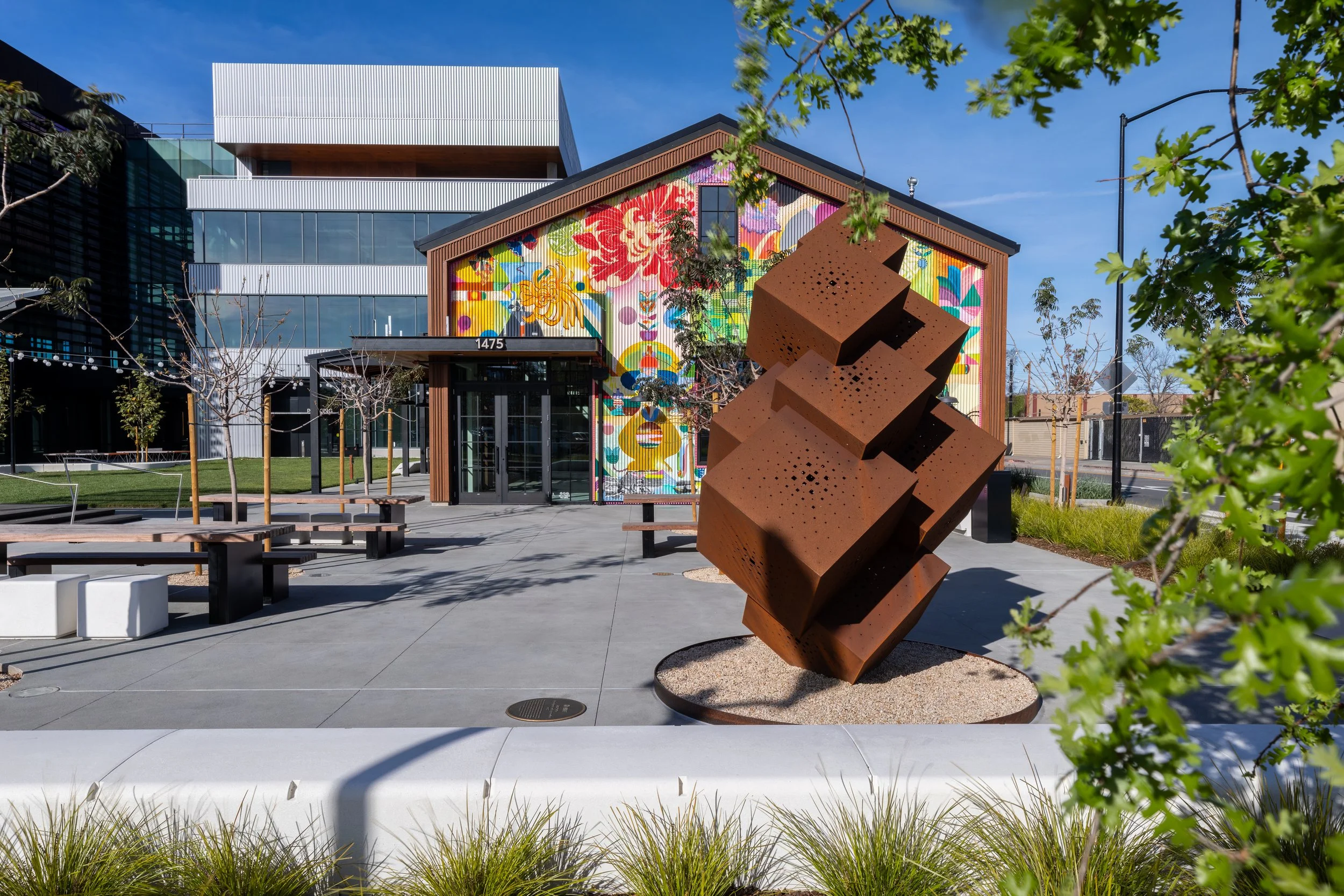
Halite by HYBYCOZO, and Caretake this Land, a mural by MCXT. Photo by Breadtruck Films, Courtesy of IQHQ.
The advisor’s perspective
The ease of encountering these works in public space rests on years of decisions made across disciplines. Marx sustained the curatorial direction through a change in ownership, public approvals, fabrication, and installation, helping artists’ intentions take shape within the development’s requirements.
Her work at Elco Yards also reflects an approach she brings to private clients: understanding the people and setting a collection will serve, presenting a considered range of possibilities, and coordinating the expertise required to realize them.
At Elco Yards, that approach has produced a collection whose connections unfold through everyday use. A bench, a pedestrian path, a dog park, and a reconstructed neighborhood landmark each offer a different encounter with art, and another way to understand Redwood City.
Visit Elco Yards: The eleven outdoor works are free to view across five blocks between El Camino Real and the Caltrain line, a short walk from the Redwood City Caltrain station.
Heather Marx is an APAA member and founder of HMxAA, a full-service art advisory serving private clients and institutions.
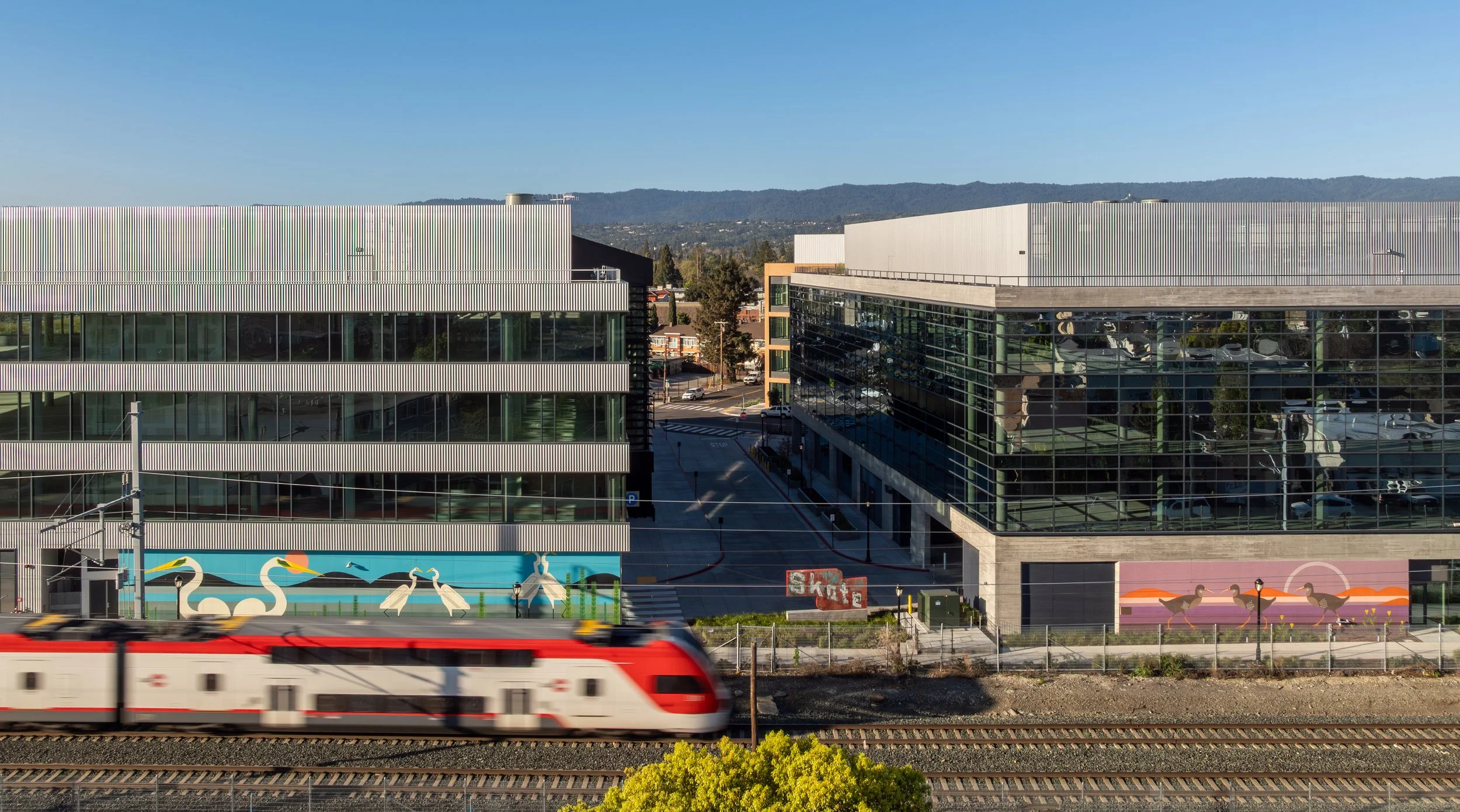
Kelly Ording, Beauty of Bair Island, 2025. Photo by Breadtruck Films, Courtesy of IQHQ.
